You have entered into the realm of my notes and my visions of these beings. You may prefer to keep them as you imagined them. However, if you dare, you are welcome to see them as they sprang from my mind.
... Refuge for the Khymera
Major Characters
Martin Godfrey
Junior high math teacher, self published sci fi author, and the accidental human who becomes the first point of contact for the Khymera. Rational, anxious, imaginative, and ultimately heroic in ways he never expected.
As with most of my books, Martin is partially me. So, this book is autobiographical in a way, except of course for the alien. On the other hand, Martin is a figment of my imagination, built from bits and pieces of my real life where useful, and with the necessary fictional additions to make the story work. He is an avatar in the world beyond the Reality Field.
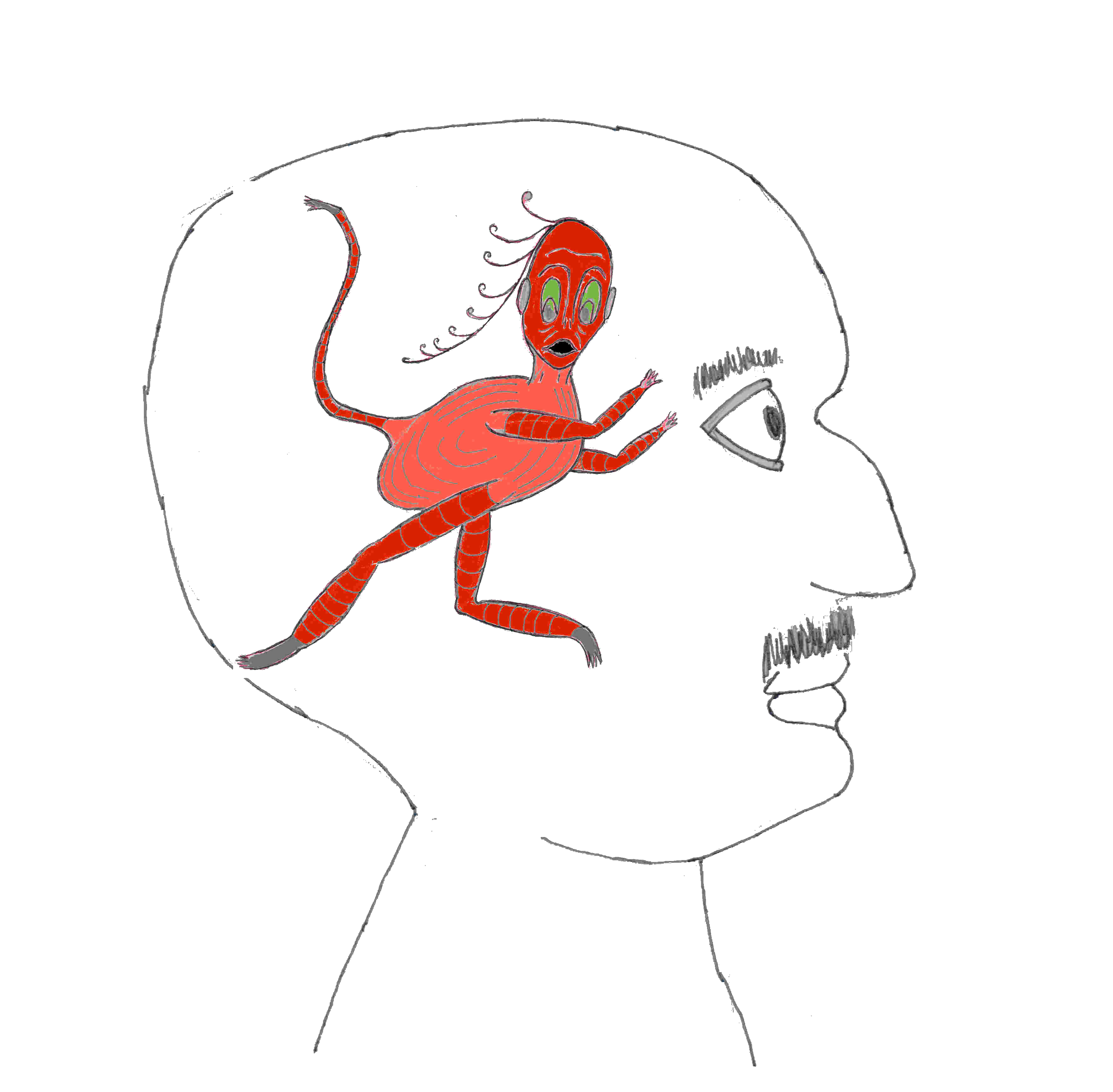
Martin teaches junior high school math, as I once did. He is 6'4" and 210 pounds, with, as you can see from the icon, a mustache. Unlike some other teachers, he wears a tie every day, and the students notice the red Welsh dragon tie tac that goes with them. Martin is kind and tolerant of his students' feelings and has attracted a fan club of some of the most intelligent and uncool students in his classes. As part of an assignment by their English teacher, Ms. Sinclair, their imaginations attach that image to the aliens they invent for "Mr. Godfrey's Galaxy" even before the Khymera arrive. Most of his students think he is ancient, although actually a younger me, about twenty-five years old.
He has recently transfered within the district, thus is alien to the new school. He is teased by the gym teachers as they would any newbie.
Martin is a self-published author of sci-fi, having written all of my actual books, as well as Outer There (so that the wild guess thing sort of works later). He attends sci-fi conventions and writer’s workshops. His readers are scattered around the world. He is nerdy, geeky, not woke, not cool, not a gamer, not a boarder. He is a runner, and does much of his writing while running. He lives in his head.
Martin has no attachments. He is single. He lives alone in his deceased parents’ big old house. His father was into genealogy, and the pictures on the walls of the billiard room fill his mind with memories and stories of the ghosts.
Every day, while teaching, he solves problems. Algebra problems with formulae. Geometry problems with proofs. Classroom problems with organization, punishment (points off), praise and rewards. He has a mathematical mind. However, he also ponders more metaphysical problems and issues of creativity. He is constantly searching for themes and ideas for his next book. His settling on bringing Sarah Connor, of the Terminator series, to life, parallels the arrival of the Khymera, Aki into his real world.
He must learn to deal with the three female (alien) characters in his life. The first, Aki, the alien Khymera bursts in uninvited. The second, Nancy Sinclair, is the developing love interest and gradual heroine of the story. The third, Sarah Connor, is drawn in by Martin's imagination, and becomes more and more real as the book progresses.
The well-known phrase, "men are from Mars women are from Venus", describes Martin's predicament. How can he understand women? Something he has to deal with as a writer, and something he has to deal with in "real-life". Is Aki a helpless female, fleeing from danger? Is Nancy flirting with him or simply being sympathetic to a nerdy guy like she treats here students? Should Sarah Connor be ...
The culmination of the chaotic merging of his worlds is the realization that his imagination is the dark matter crystal, key to crossing the Reality Field, that Aki and Hoorookai have come here to find.
Nancy Sinclair
English teacher at Martin’s school. Practical, empathetic, grounded, and unexpectedly brave. She becomes Martin’s partner in survival and emotional anchor.
Every hero needs a heroine. Nancy is Martin's "editor", an English teacher who is "not into" fantasy and sci-fi. But she is "into" this sci-fi, like it or not. She says at the start, “I don’t want my life to change. It’s fine just the way it is.” However, her life changes dramatically because of Martin, evolving from colleague, to rescuer (at the Purple Crow), to partner in crisis as the Phack chase the Khymera through their world, and ultimately his emotional partner. Thematically she represents realism to balance Martin's imagination, which is the core tension of the book. Nancy repeatedly asks, “What is actually happening?” while Martin asks, “What could this mean?”
She declines to edit, believing Martin's writing has too many sentence fragments, too much slang, and too much detail. She likes emotional realism like Faulkner, O’Neill, Cather, and Hemingway.
It is unclear if she is seeing someone, but in the end that doesn't matter. She is an only child. Her parents lived several hours away. She grew up Methodist. She is practical, organized, and emotionally intelligent. She is protective of her students as they get involved in the rescue of the Khymera.
Her English term project to develop a story line and then write a play or a short story or an epic poem has prompted Martin's fan club into creating an animated cartoon online called "Mr. Godfrey's Galaxy". They have Martin married to a space alien. That, and a natural attraction to Martin draws her into his life. She stands up for him against the other teachers at the Purple Crow, and since he is too drunk to drive, drives him to his home. Her actual reactions to meeting Aki for the first time are not described, since the story is told by Martin, and he has passed out. However, when Martin comes to her apartment the next day, she is not panicked. She is courageous under pressure.
She is immediately suspicious of Aki, and tries to protect Martin from his trusting instincts. She is skeptical, but adaptable. Despite her distrust of Aki, Nancy is protective of the Khymeran children. Nancy grows in strength and courage like Sarah Connor as the war comes to Earth. During the school lockdown and the rescue of Aki's husband, Hoorookai, she becomes a leader. She coordinates the fan club and the extraction of the Khymeran children. She spots the Phack attack on the parkway and helps keeps them alive. On Ossifay she becomes Martin's emotional anchor as they survive the war between the Thinmen and the Phack.
Even at the end, Nancy is rational, realistic, and practical, the perfect partner for Martin.
Aki Koaloakai
A Khymeran scientist who initially pretends to be a princess. Curious, intelligent, evasive, and morally conflicted. Her arrival triggers the entire chain of events.
Khymera is my space alien version of the Greek mythological "chimera", which has come to describe any mythical or fictional creature with parts taken from various animals. That is exactly what I see when I imagine Aki. Part this. Part that. The crude drawing of the dancing red devil on the cover of the book is simply my feeble attempt at capturing her image.
Her voice was more fluid than a computer generated translation, almost musical, with word chords, as if in its natural language, meaning could waver, trill, and vibrate, and it tried to speak English in the same way.
It is revealed that she has a husband/mate and two kids, and that she is waiting here for them to come. Her home planet is Onturo. Ossifay the nearest safe planet.
I have discovered something unexpected about Aki and the process of writing itself. Aki is truly alien. Some strange here-to-there device has allowed her idea to wander through my mind, leaving footprints and traces of her passing. When I look at her now analytically, rather than as she sprang from my imagination, she is not as simple as she first seemed to me. Even now, Aki changes constantly.
She is the only character whose identity is deliberately unstable. She is a liar, so beware what you think about her. She arrives as a frightened childlike figure. She reinvents herself as a princess to manipulate Martin’s empathy. She reinvents herself again as a scientist to regain authority. She finally reveals herself as a refugee fleeing genocide. This isn’t just plot — it’s theme. Aki embodies the danger of believing the story you want to hear. Martin wants wonder, so she gives him wonder. Martin wants meaning, so she gives him meaning. Martin wants to be chosen, so she chooses him.
I intended Aki to be the archetypal evil alien, although subtly. But Aki is not evil, although she is not innocent either. She lies because she must, out of fear and self preservation. But she also lies because it works. She hides truths that would have changed everything. She uses Martin’s compassion as camouflage. She is sympathetic, but not trustworthy. She is desperate, but not helpless. She is grateful, but not loyal. She is a survivor first, a friend second. I used Aki to pull Martin into the plot. I did not write from her point of view. Now I think it would be fascinating to do so.
What symbolism hides behind her cloak of invisibility? What lies outside the quarantine? Aki and other "chimera" can bring with them war as they break that quarantine and trigger a cascade of thought-refugees. She is only one frightened thought-mother among thousands, swept up in a cosmic disaster.
Aki represents the seduction of imagination, the danger of believing your own stories, and the collision between fantasy and reality. She should make the reader consider the moral cost of survival, the limits of empathy, and the fragility of trust between species. She is the embodiment of the book’s central question: What happens when the stories we tell ourselves become real — and then betray us?
I have said that she can read minds, probably with the help of some device in her crest. However, humans are alien, and despite her expertise in the species, Martin's thoughts are not quite clear to her. Has she been reading my mind as she races through it? What did she do hiding inside yours for a while?
Secondary Characters
Hoorookai - Aki’s husband, also a Khymeran scientist. Injured, irritable, proud, and deeply protective of his children. His arrival reveals the truth about the Khymeran war.
The husband who lost the children. At least he did not just leave them on the subway car. He has the excuse of being shot by a Phack and barely escapes with his life. He desperately searches Martin's house for the dark matter crystal.
The Khymeran Children - Aki and Hoorookai’s offspring. Intelligent, frightened, and capable of limited English. Their disappearance and rescue drive the middle of the story.
Sarah Connor - the main character of Martin's next book
The entity, Sarah Connor, is the collection of all thoughts about that fictional character that have accumulated according to the laws of psychic-gravity on the other side of the Reality Field, the collective unconscious of the universe. Martin has written about that place in one of his series, and has decided to reach into it and draw Sarah Connor out as the main character of his next novel. He is her Dr. Frankenstein. The personality he imagines arrives at the Long Island Railroad train station bewildered, but strong and capable. Sarah Connor is so strong and capable that even as Martin and Nancy struggle to survive the war on Ossifay, Sarah can inspire Martin. Which Sarah Connor is it? The character in Martin's book? The thought cloud in the Ideastorm? A new creature, alive in Martin's world independent of his control?
Sheldon, Mercedes, Brad, Danny, Larry - Martin’s “fan club” — a group of bright, nerdy, enthusiastic students who accidentally become involved in first contact. They provide humor, heart, and unexpected heroism.
Brad, Danny and Larry really existed! Many years ago. That was long before personal computers and the internet, so their creation was an illustrated book and a newsletter. Yes, they were fascinated by my tie tac, which was a frog that they named Bruno. Mercedes was the star of another class, a real leader. Sheldon was actually one of my wife's students, always raising his hand with an answer. They probably all have grandchildren by now. I wonder if they would recognize themselves if they read this book.
Angie & Larry (the gym teachers) - Comic antagonists in Martin’s school life. Represent the mundane social pressures that contrast with the cosmic stakes.
They were real colleagues that I used to eat lunch with in the teacher's lunch room. Yes, they did give me a hard time. But I suppose this is the last laugh, "Be careful, or you'll end up in my next novel."
Sal - Martin’s department chair. Supportive, oblivious to the alien drama, and a source of normalcy.
The FBI / “Men in Black” - Agents who investigate the alien sightings and briefly raid Martin’s home. Their presence adds tension and realism.
The Phack - The antagonistic species hunting the Khymera across the galaxy. Angelic in appearance, genocidal in behavior. Their arrival escalates the story into a full scale interstellar crisis.
The Thinmen - Tall, technologically advanced inhabitants of Ossifay. Locked in their own war with the Phack. Their world becomes the setting for the climax.
Minor characters The face painter, ninja artist, and other vendors at the sci fi convention - The Borg ticket taker - The marching band - The pizza place man, supermarket clerk, and townspeople - The priest at St. Cabrini - The homeless women near the church - Various Khymeran refugees - The opossum in Martin’s yard** (a small but memorable cameo)